
How we orchestrate time determines how readable a system feels once it starts to move. Schedulers manage the 'tick' of the machine, ensuring that priority tasks and cooperative background work stay in balance.
Software / Engineering Depth
Orchestrating Time and Priority
In a single-threaded runtime, the Scheduler is the sovereign that decides what lives and what waits. This surface explores the mechanics of (cooperative multitasking): yielding to the main thread, managing [priority levels], and protecting the user experience from <long-task starvation>.
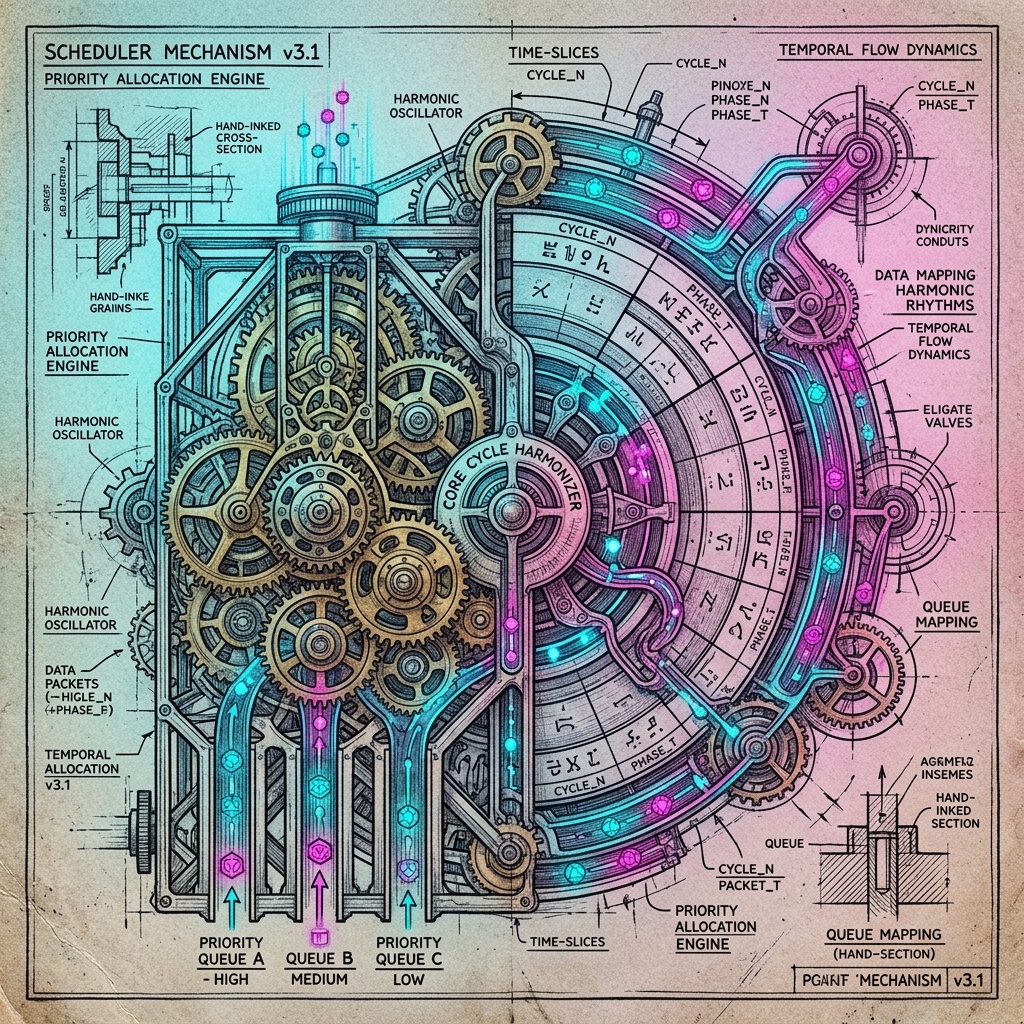
Task Priority Queues
Not all tasks are created equal. A click response must beat a background analytics ping. The Prioritized Task Scheduling API gives us formal handles to signal intent to the browser's event loop.
Prioritized Task Scheduling
The scheduler.postTask() API allows enqueuing tasks with explicit priority levels and dynamic cancellation via signals.
- user-blocking
- user-visible
- background
- postTask
#>task_priority_dispatch
#!runtime/scheduler

^"dispatch"{
  controller: new TaskController({ priority: "user-visible" })

  scheduler.postTask(() => {
    // perform critical work
  }, { signal: controller.signal })

  // later: upgrade priority
  controller.setPriority("user-blocking")
}
Cooperative Multitasking
Long tasks are the death of responsiveness. By yielding control back to the event loop, we allow the browser to process high-priority inputs and rendering before resuming our work.
requestIdleCallback
The original cooperative primitive. It allows background processing when the main thread is quiet, ensuring expensive metadata calculation doesn't block critical frame timing.
- deadline
- timeRemaining
- didTimeout
Yielding and Signal
scheduler.yield() creates a continuation point in a task chain. It lets the browser breathe without losing the application's current state—crucial for heavy parsers and simulators.
- AbortSignal
- TaskController
- Microtask
Priority Inversion
A classic concurrency bug where a background task indirectly blocks a user-visible one. Detecting these "Long Tasks" via the PerformanceObserver is essential for maintaining the 16ms frame budget.
- Long Tasks API
- INP
- Priority Inversion
Staff Engineering Deep-Dive
For principal leads: how we model time determines the durability of the publishing pipeline. Consider these architectural constraints when leading a team towards modern production.
Cooperative Multitasking
In a browser-first runtime, the main thread is a constrained resource. Staff leads must choose between synchronous 'magic' and predictable cooperative yields (requestIdleCallback, scheduler.postTask).
Priority Inversion
When high-priority text layout is blocked by low-priority background indexing, the user experience fractures. Spw models these as explicit layers of consideration to prevent implicit inversion.
Mathematical Alchemy
The scheduler is a priority queue over a time-indexed lattice. By treating tasks as 'spells' with measurable costs, we can project a stable UI even during dense data mutations.
Scientific Resonance: Lattice Dynamics
Research Primer: How does clock-speed synchronicity translate into the 'Rhythmic Coherence' of a collaborative publishing pipeline?
Molecular Schedulers
Tasks in a cognitive lattice behave like particles in a crystal. High-performance schedulers must manage the 'thermal noise' of asynchronous interrupts to maintain a stable, rhythmic state (molecular resonance).
Cognitive Rhythm
The human heartbeat and the CPU clock are both oscillators. Staff leads should bridge these domains by building systems that pulse at biological frequencies, reducing the 'metabolic cost' of digital interaction.
Sustainable Pipelines
By treating the scheduler as a resonant circuit, we model project-based learning as a self-sustaining cycle of energy (discovery) and stabilization (publishing), preventing lead burnout through rhythmic flow.