RPG Wednesday / Character Development
Develop One Character at a Time
A character sheet is a pressure map for a person who is not finished becoming real.
This page is for the player as an individual. Start with a person, not the whole party. Name them, give them art, and record the pressure that makes them feel specific.
If you have never kept company with a character this way before
Begin in the Library garden with a Character Seed. It asks only one small question: what kind of helper would this world need? Later, when the person has weight, this workshop is where you give them a face, a voice, and the five boonhonk questions that a long family would ask before letting them carry real consequence. The translation sheet is the tool that lets the life you imagined speak clearly to someone who was not in the room when the story happened.
You do not need to master every part of the site’s grammar at once. The operators are gestures the character can learn. The kernel is the naming engine you can bring with you. The work teaches itself the longer you tend one life.
Development here is deliberately plural. A character can help someone think about human development, software development, spiritual development, social development, or stranger wonder-bearing paths that do not fit one profession cleanly.
Cast is where recurring figures become collective memory. This page comes first. It is the more private workshop where someone can figure out who they are playing, how they look, which literacies they are developing, and which details are worth carrying into a session, a screenshot, or a later character sheet.
Table narrator: what if the page only has to do six things well at first: hold a name, face, role, pressure, development vector, and proof of recurrence?
The ordinary profile builder and the RPG character card are relatives. A professional profile names work, status, skills, and context. A character profile names role, pressure, relation, disposition, and scene consequence. Both become stronger when the card can be screenshotted, exported, and revisited.
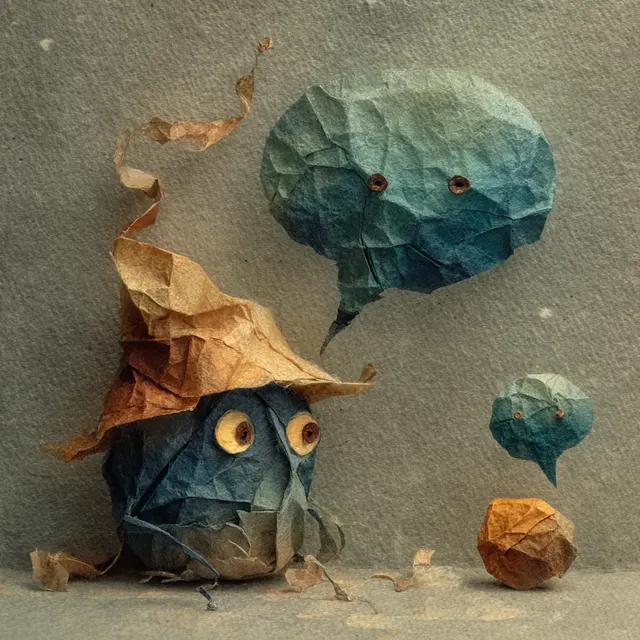
Clay golem, speech-bubble metaphysician
The last name is a jumble of consonants that sounds like an affirmation from a bushy-mustached bar patron. Main magic: speech bubble metaphysical expertise — operators and sigils as inner-speech acts; the page's attentional handle and resonance probe as subvocal echo chamber. This is a reason to explore the cognitive metaphysics of linguistics and how we can relate to materials (cards, tokens, surfaces, cauldron ingredients) the same way we relate to paint or art materials. Branch into real physics (charge quanta, variability by reason, gravitational "down" pacing of sections) with room for accuracy-focused or fantasy players to describe dynamics they'd like.
Collect this note (badge modes: skim/activate for unique copy + transient toast) to the cauldron. Use cauldron hook from footer to jump back here and highlight. Cycle charge/spacing/component-variant on design or via settings to feel the bubble swell, surface yield, or regional semantics shift. Nook demos and visibility modes let you tune how candidates and feedback appear during rehearsal.
Thinking handles and topic links
These links are metacognitive handles. Use them when you need a clearer kind of thought, not just more reading.
The living tools you carry while you tend a character
When you work on one person over time, these four practices become companions:
- Semantic enhancements — the clear labels and handles that let the character (and the world around them) remember what they are becoming.
- Brace physics — the attentive gestures of holding, priming, and releasing meaning. A long-held observation or contradiction can be gathered and offered to the cauldron.
- Cauldron collection — the quiet garden at the bottom of the page where daily pressures, journal lines, and primed semantic forces rest until you are ready to mix or plant them.
- Spell navigation — the trails your attention leaves. The spell path that travels with you and the spells you cast from gathered material are the memory that survives from one session (or one decade) to the next.
These are the same tools the Library garden offers, now applied to the intimate work of keeping company with one life. The character sheet builder and the Midjourney bench are simply places where these forces take more durable or visible form.
a person is easier to revise locally before they become part of the public cast memory.
you have a portrait, a voice, or a development lane that still needs private refinement.
character notes, portrait studies, session hooks, and later cast references.
Quick Entry
1. Name the person
A name is enough to begin. Do not wait for a fully optimized backstory.
2. Add art
Upload a portrait, screenshot, sketch, or image-study. Even imperfect art gives the table a stable face to return to.
3. Write one hook
One line of current pressure is more useful than a dense biography when the session is about to begin.
4. Name the development lane
Ask what is actually growing here: code fluency, artistic craft, social courage, spiritual posture, statistical literacy, nutritional attention, or something else.
5. Promote later
Once the character recurs, move the stable version into cast memory or the translation sheet.
A composable character card usually holds the same fundamentals in a slightly different order: name, face, role, pressure, properties, development vector, proof. Topic routes help when one of those fields needs a clearer language.
For a live stream or week of production, use the character lab as a catch basin: paste the properties someone gave you, save a rough card, and let the repeated chips teach your eye what belongs to that person.
Use the profile card as a boonhonk mixer.
A full profile can name all five: what supports the character, what stabilizes them, what fails them, what experiments with them, and what rewards discovery. A scene can start with one or two.
boon
What makes the character more generous or possible?
Name a gift, alliance, ingredient, spell, joke, or habit that opens better choices.
bone
What is the stable skeleton?
Name the default posture: oath, job, appetite, body, rhythm, familiar tool, or repeated line.
bane
What breaks, tempts, or narrows the character?
Use failure as playable information: a fear, cost, debt, false closure, or social wound.
bonk
What happens when the character experiments badly?
Bonk is collision as research: a clumsy test that teaches a rule the table can remember.
honk
What rewards discovery?
Honk is the strange flourish that makes the table lean in: timing, reveal, soundless gag, spell twitch, or visual motif.
Development Literacies
Use this as a shelf, not a checklist. A strong character often becomes legible by showing which literacies they are trying to grow, braid, or reconcile.
Human literacy
Boundaries, care, pacing, trust, repair, desire, grief, appetite, and the ordinary work of staying recognizable to oneself.
Software literacy
Typing, debugging, architecture, naming, systems thinking, tool fluency, and the emotional pacing of working inside a codebase. The nearby algorithm visualization route helps when procedure wants a clearer picture.
Visual literacy
Composition, silhouette, palette, symbol, SVG, image studies, and the ability to make a surface readable at a glance.
Narrative literacy
Hooks, recap structure, scene pressure, metaphor, cadence, and the difference between a joke, a motif, and a law of the world.
Statistical literacy
Uncertainty, evidence, baselines, sampling, trend versus noise, and how to ask whether a pattern is actually holding. Use statistical analysis when the table needs a more explicit evidence vocabulary.
Nutritional literacy
Inputs, energy, appetite, ingredients, chemistry, and how meals change the felt texture of a day or week.
Spiritual literacy
Ritual, reverence, conscience, devotion, wonder, and the ways a person interprets contact with meaning beyond utility.
Social literacy
Groups, witnessing, coordination, timing, collaboration, and the conditions under which a shared rhythm can hold. The scale intuition route helps once a character issue starts behaving like a room, faction, or civic pattern.
Character Development
Enable JavaScript to draft local character cards in this browser. The static page still gives the workflow, but the local deck is the faster path for tonight.